Paramount Commits to Releasing at Least 30 Films a Year Following Warner Bros. Discovery Merger
Paramount settled with 12 states in the lawsuit filed against its $110 billion merger with Warner Bros. Discovery. The company committed to releasing at least 30 films a year after the merger and to spending at least $300 million more on US productions; however, the settlement terms will remain in effect for only five years.
Paramount has reached a settlement with 12 states that had sued to block its $110 billion merger with Warner Bros. Discovery (WBD). According to the company's statement, under the agreement Paramount will spend at least $300 million more on film and television projects produced in the US and will release at least 30 films a year after absorbing WBD.
In his statement on the settlement, California Attorney General Rob Bonta said the agreement aims to sustain steady film production and domestic production, as well as to "protect the livelihoods of both above-the-line and below-the-line workers." Screen Actors Guild – American Federation of Television and Radio Artists (SAG-AFTRA) President Sean Astin and chief negotiator Duncan Crabtree-Ireland, in their own statement, thanked Bonta and said the settlement represents "the minimum standards our employers must meet."
Terms and Duration of the Settlement
Although the acquisition, which has not yet been formally completed, will permanently combine Paramount and WBD, the settlement requires the new company to comply with certain rules for only five years. In the first two years, the combined company must either release 30 films a year or pay $30 million for each film into the health and pension funds administered by Hollywood's largest unions. In the following three years, the requirement is to release 32 films a year. If any of these conditions is not met during this five-year period, the company will have to sell its 49 percent stake in Miramax Studios to one of its competitors.
Current Production Figures and Targets
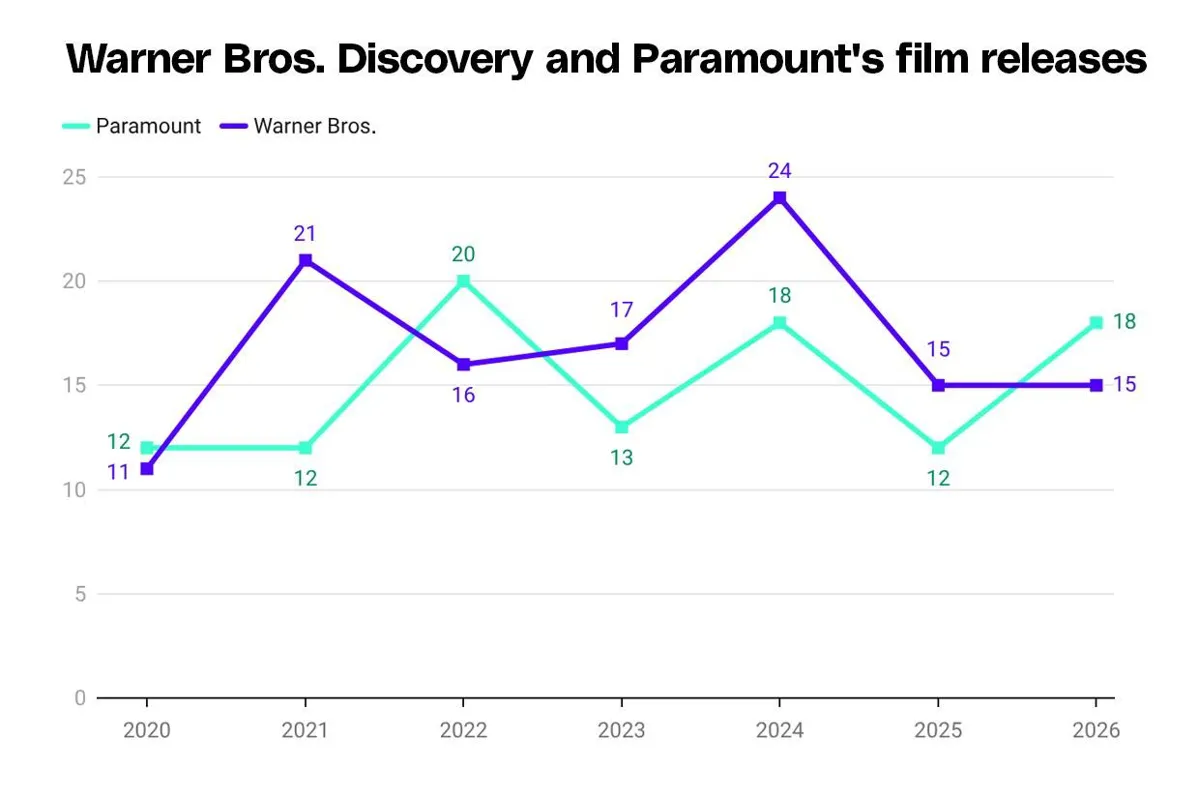
In terms of production volume, these targets also represent an increase for Paramount and WBD, which operate as separate companies. Over the past six years (including projects slated for release in 2026), Paramount released an average of 15 films a year, while WBD released an average of 17. Assuming the combined company sticks to the release calendars previously announced for 2027 and 2028, it will need to add several more projects to the schedule to avoid multimillion-dollar penalties.
The Distribution Instead of Production Option
But this is probably not a major concern for Paramount, because the settlement does not require the new company to produce the projects needed to meet its annual film quota. Paramount/WBD can fulfill its obligations by distributing films acquired from other production companies. Although these films will carry the Paramount/WBD brand, they will be products created through the efforts of teams with no direct connection to the studio. The company could also focus on entirely new original films that it approves and finances itself. However, many of these films may look less ambitious, because the settlement stipulates that only 20 percent of the films may have production budgets above $50 million.
Paramount appears to have convinced Bonta and the other attorneys general that absorbing WBD would give the company the ability to essentially double its normal production. But this logic assumes that after Paramount and WBD merge, every stage of both studios' production pipelines will continue to operate normally. Although Paramount/WBD could increase in-house production, the far more likely scenario is that the studio will make a minimal effort to comply with the settlement terms. All the details of the settlement suggest that Ellison is playing a long game and that once these safeguards disappear within five years, Paramount/WBD will be in an even stronger position to shape the broader entertainment industry.